

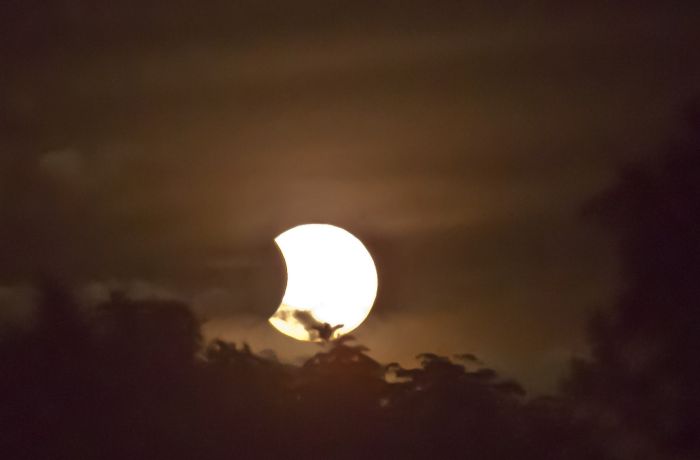
As you know, a total solar eclipse occurs because the Moon moves directly in front of the Sun and blocks it from our view. The apparent size of both celestial discs in the sky is very similar (the Moon is 400 times smaller than the Sun, but it is also 400 times closer to us), and they match each other perfectly. This makes the cosmic coincidence even more spectacular and also means that the Moon’s shadow on the Earth’s surface is only a broad spot a few hundred kilometres across. Thanks to this, the Greeks were able to calculate the size of the Moon and the distance between it and us, as explained in this book: https://alvarelloseditora.gal/libro/a-que-altura-esta-o-ceo/. Incidentally, since the Moon is moving away from us by 3.8 cm each year, in 600 million years it will be far enough away for its disc to appear too small, and there will no longer be total solar eclipses.
If the Earth and the Moon orbited in the same plane, there would be a total solar eclipse and a total lunar eclipse every 28 days: when there was a new moon (with the Moon between the Sun and the Earth) and when there was a full moon (with the Earth between the Moon and the Sun). But the plane of the Earth’s orbit around the Sun is not the same as that of the Moon around the Earth: they are tilted relative to each other by a small angle, 5°, and so the usual thing is for the shadows not to line up in a way that produces eclipses. Even so, roughly every two years a total solar eclipse takes place somewhere on the planet (we have already had 15 total eclipses and 18 annular ones in the 21st century).
And what about the European Union? It is a leading part of the world, but the area it covers amounts to less than 1% of the Earth’s total surface… so it happens here very rarely. The last one was in 1999, with the shadow falling mainly over France. The next one, and the first in Europe in the 21st century, will take place on 12 August 2026, with Spain — and Galicia — in a privileged position. The fact that this will happen in a developed country, the world’s second-largest tourism power, will unleash an extraordinary wave of astronomical excitement.
It will last only an instant, but just remember the frenzy that took place in the United States in 2024 to witness what happened across large parts of the country, seen directly by around 50 million people.
Why such fascination? Because it is astonishing to see daytime suddenly turn into night and, above all, because we know how unlikely it is for something like this to happen close to home. Consider this: the last time one was seen in Galicia was in 1912, and after the 2026 eclipse the next one will not occur until the year 2180. In the European Union, after the 2027 eclipse over Cádiz, there will not be another until 2053 — also over Cádiz — and then another in 2081 in northern France.
The observation band will be about 250 km wide, but interestingly the southern boundary of that band passes right through the Costa da Morte, cutting it diagonally in two through the municipalities of Zas and Cabana de Bergantiños. This means that the northern part of our region will experience total darkness, and the farther north you go, the better. If you are very close to the boundary of the eclipse, you will see totality only for a short time. Since we are right on the edge, moving just a little farther north gives you much more time in shadow. In A Carballa (Cabana) or Budián (Zas), it will last only 1 second; in Ponteceso, 13 seconds; in Coristanco, 33; in Carballo, 45; in Malpica, 49; and in A Laracha, 54 seconds. Within the Costa da Morte Starlight destination, the municipality of A Laracha will be the best place and, within it, Caión: there totality will last 1 minute and 2 seconds.
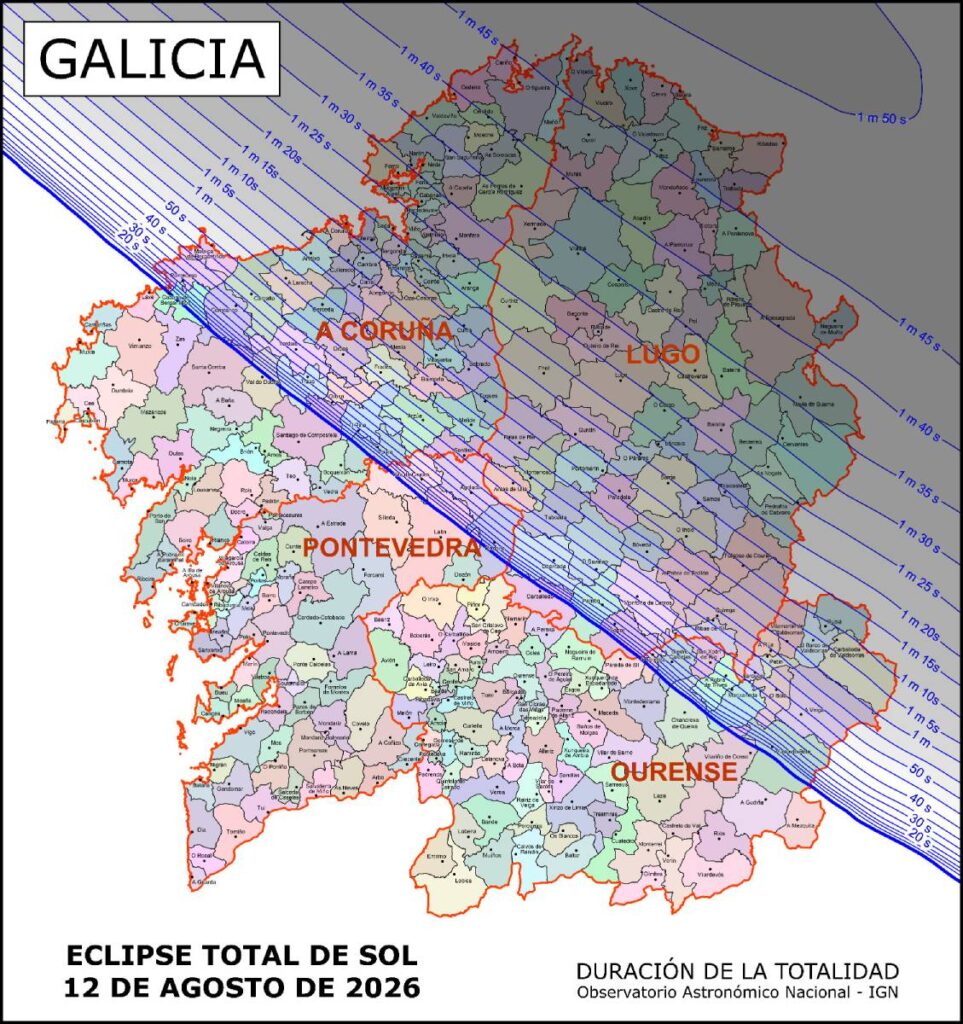
From Cabana de Bergantiños and Zas southwards, the eclipse coverage will be 99%. That may sound almost like seeing it in full, but believe me: the difference between being on one side or the other of the shadow boundary will literally be the difference between day and night. The 1% of the Sun still left uncovered in the southern area gives off as much light as 4,000 full moons.
There will be huge population movements, so many precautions will be needed, both logistical and health-related. In March 2026 I organised a meeting of experts at the Consello da Cultura Galega and, based on that, we produced a set of recommendations that I strongly suggest you consult. You can find the text at this link: https://consellodacultura.gal/publicacion.php?id=4555
And since the eclipse will take place with the Sun very low in the sky — only about 12° above the horizon — a nearby building, some trees or even a rise in the terrain could block the view. To prepare for this, I suggest you note down 30 April at around 20:23. On that day and at that time, the Sun will be in almost exactly the same position in the sky as it will be on 12 August at 20:28 (it is the symmetrical point in the Earth’s orbit). So on that date and at that time, check that the Sun is visible from the spot where you plan to watch the eclipse.
Enjoy the eclipse!